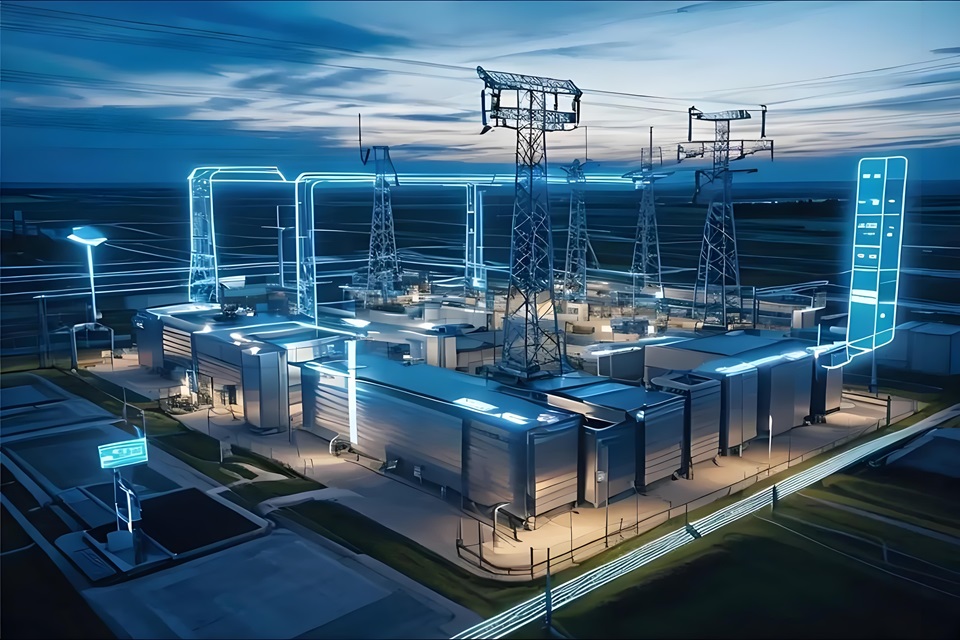
A substation is a crucial facility in the power system that is responsible for transforming voltages, receiving and distributing electrical energy, controlling the flow of electricity, and adjusting voltages. It connects different voltage levels of power grids through transformers and serves as the core hub in the process of transmitting electrical energy from power plants to users.
The main equipment of a substation includes transformers, circuit breakers, disconnectors, instrument transformers, lightning arresters, busbars, capacitors, reactors, as well as various secondary control and protection devices. These devices work together to ensure the efficient and safe transformation, transmission, and distribution of electric energy.
Primary Equipment: Core equipment directly involved in the transformation and transmission of electric energy.
Transformer
As the "heart" of a substation, the transformer is responsible for voltage regulation, enabling the long-distance transmission and end-use of electrical energy. The step-up transformer is used at the power generation end to increase voltage to reduce line losses; the step-down transformer converts high-voltage electricity into low-voltage electricity suitable for industrial or residential use.
Circuit Breaker
It has a strong arc-extinguishing capability and can reliably connect and disconnect circuits in normal or fault conditions. When a short circuit occurs in the system, the circuit breaker can act quickly to isolate the fault current and protect the power grid safety.
Insulators
Used to isolate live conductors from towers to prevent current leakage. Common types include suspension, pin, and composite insulators, widely used in overhead lines.
Isolating Switch
It provides an obvious break point for the circuit, ensuring the safety of maintenance personnel. Due to its lack of arc-extinguishing function, it must be operated after the circuit breaker is disconnected and is strictly prohibited to operate with a load.
Busbar
It is equivalent to the "power main road" of the substation, used to collect and distribute electrical energy from transformers or transmission lines, and connects various primary equipment.
Instrument Transformer (Current Transformer CT and Voltage Transformer PT)
It converts high voltage and large current proportionally to a standard low voltage (such as 100V) and a small current (such as 5A or 1A), providing for measurement instruments, relay protection, and automation systems. It is the basis for achieving monitoring and control.
Fuses and Lightning Rods
Fuses are used to absorb lightning waves or operational overvoltage energy to prevent insulation breakdown of equipment; lightning rods guide direct lightning into the ground to protect equipment in the station from direct lightning strikes.
Capacitors and Reactors
Capacitors are used for reactive power compensation, improving power factor and voltage quality; reactors are used to limit short-circuit current, suppress harmonics, and maintain system stability.
Secondary Equipment: The "nervous system" that ensures the safe operation of the system.
Relay Protection Device
Real-time monitoring of the operation status of the power system. In case of a fault, it promptly issues a trip command to cut off the faulty part and prevent the accident from escalating.
Measurement and Control Automation System
Collects remote measurement data (voltage, current, power, etc.), executes remote control commands (such as switching on and off), and realizes remote monitoring and dispatch control.
DC Power Supply System
Provides stable and reliable power for relay protection, control circuits, and communication equipment, ensuring normal operation even in the event of an AC power failure.
Monitoring and Measurement System
The background monitoring system displays the equipment status in real time and supports fault diagnosis; the metering device precisely records the electricity consumption and is used for billing and management.
III. Intelligent Development Trend: From Traditional to Intelligent Substations
Modern intelligent substations adopt electronic transformers, intelligent switches, and IEC61850 communication standards to achieve digitalization of information, networking of control, and integration of functions. Through a unified information platform, it supports visual status, automatic control, online analysis, and collaborative interaction, significantly improving the operational efficiency and reliability of the power grid.
In ultra-high voltage projects, such as the 1000-kilovolt AC project from Datong to Tianjin Nan, 1100kV gas-insulated metal-enclosed combined electrical apparatus (GIS) has been widely used. It integrates circuit breakers, disconnectors, and transformers, with advantages such as small footprint, high reliability, and adaptability to harsh environments.