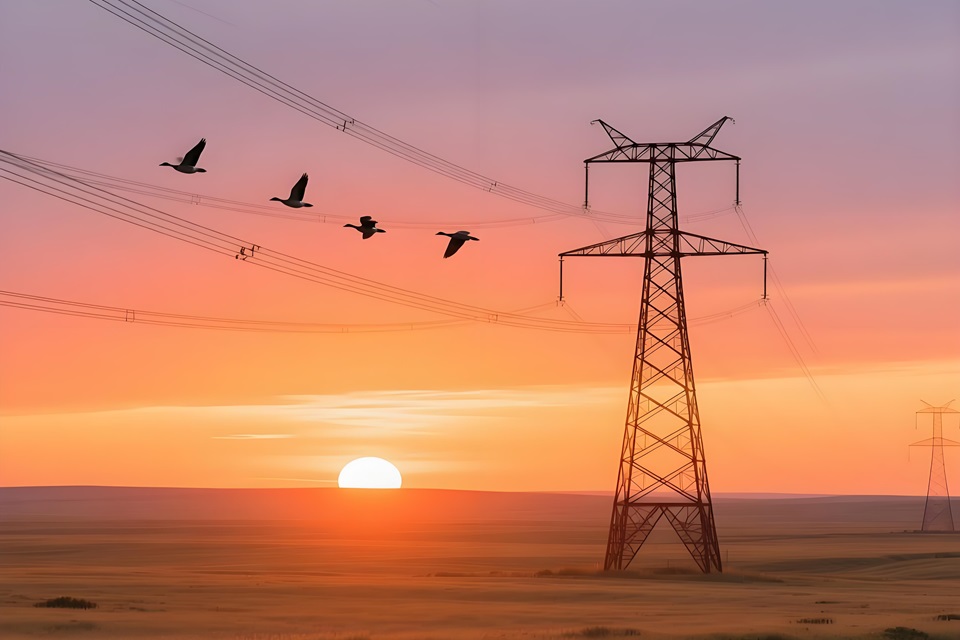
Power transmission and transformation lines are the key components in the power system for the long-distance transmission and voltage transformation of electric energy. They are mainly composed of transmission lines and substations. Their core function is to convert the electric energy generated by power plants through voltage boosting, transmission, and voltage reduction, and then distribute it to industrial, commercial, and residential users, ensuring the safety, stability, and efficiency of power supply.
Conductors and Ground Wires
Conductors are the carriers of electric energy, typically using steel-cored aluminum
stranded wires for good conductivity and mechanical strength; ground wires are used
for lightning protection to ensure line safety.
Towers and Foundations
Towers support conductors and ground wires. They are classified into suspension
towers, tension towers, and angle towers, mostly made of reinforced concrete or
steel, and must be firmly fixed to the foundation.
Insulators
Used to isolate live conductors from towers to prevent current leakage. Common types
include suspension, pin, and composite insulators, widely used in overhead lines.
Fittings and Guy Wires
Fittings include suspension clamps, tension clamps, and connecting fittings, used to
fix and connect conductors; guy wires enhance tower stability, especially used in
angle or terminal towers.
Grounding Devices
Conducts lightning current or fault current into the earth to protect equipment and
personnel safety, serving as a vital part of lightning protection and safe
operation.
Transformers
Realize voltage step-up and step-down; they are the core equipment in the
transmission system, converting high voltage into voltage levels suitable for
long-distance transmission or user consumption via electromagnetic induction.
Circuit Breakers
Capable of connecting or interrupting circuits under normal and fault conditions,
especially acting quickly during short circuits to protect the system from damage.
Isolating Switches (Disconnectors)
Provide a visible break point in the circuit to ensure maintenance safety. They have
no arc-quenching capability and must be operated under no-load conditions.
Instrument Transformers (Current & Voltage Transformers)
Convert high voltage and large currents into standard low voltage and small currents
for measuring instruments and relay protection devices, enabling system monitoring
and protection.
Reactors and Surge Arresters
Reactors are used to limit short-circuit currents and regulate voltage; surge
arresters absorb lightning or switching overvoltage energy to protect equipment
insulation.
Relay Protection Devices
Monitor system status in real-time and automatically isolate faulty sections to
ensure grid stability.
Communication & Automation Control Systems
Facilitate information exchange between substations and dispatch centers, supporting
remote monitoring and intelligent scheduling.
Gas Insulated Switchgear (GIS)
Integrates functions like circuit breakers, disconnectors, and instrument
transformers into a sealed space, suitable for space-constrained scenarios like
urban substations.
China has established a UHV transmission network featuring "Three AC and Four DC" lines, widely applying new technologies such as Smart Grids and VSC-HVDC, significantly improving system efficiency and reliability.